


Description
An endowment to ensure essential freedoms
For the past eight years, under Mark Jackson’s leadership, Cornell’s First Amendment Clinic has successfully advocated for clients across the political spectrum to protect their fundamental free speech and free press rights. Now, you can ensure that the Clinic is able to expand its reach and extend its impact by taking on more cases throughout the country—wherever the right to free speech and a free press is being threatened.
We are more than halfway to our $1 million campaign goal to support the First Amendment Clinic, with the intent to endow the Mark H. Jackson Directorship when he vacates the role—honoring Mark’s lifelong commitment to free speech and ensuring the Clinic’s work lives on. Since the campaign launched last year, we have already raised more than $550,000. With your help, we can reach the $1 million goal, making the Clinic eligible for an additional $2 million in funding. That would be a 2-for-1 match on your gift.
Your gift creates a permanent foundation for the Clinic’s growth, supporting its essential work—not just today—but for a new generation of legal advocates and warriors.
Click to watch a short clip of Mark describing the importance of the Clinic’s work.

Create an enduring impact
By supporting the endowment, you are permanently securing the Clinic’s capacity to:
PROTECT free speech rights across the political spectrum
The First Amendment Clinic stands as a fiercely nonpartisan defender of free speech and a free press. We take on cases regardless of viewpoint or belief when there is a genuine threat to fundamental Constitutional freedoms. Our diverse casework includes:
- Challenging library book bans and anti-protest statutes.
- Supporting students’ rights to express conservative political viewpoints.
- Defending local journalists against costly defamation suits.
EXPAND our reach: More cases, more defenders
The Clinic’s resources and expertise are in extremely high demand. The endowment will provide the dedicated resources necessary to:
- Increase capacity to handle more pressing First Amendment cases nationwide.
- Provide valuable, hands-on training in complex Constitutional litigation to more students.
- Build a larger, more connected network of principled First Amendment defense attorneys.
FOSTER sustainable, impactful journalism
Through its groundbreaking Local Journalism Project, the Clinic not only protects and defends journalists but also provides them with a full range of legal services to sustain their underlying business models, ensuring local news can thrive as an essential pillar of democracy.
SUSTAIN democracy at the local level
A new initiative, the Local Government Project, examines how democratic values—especially free expression—are functioning at the local level. The project’s initial focus is on school boards across New York State, collecting and analyzing their policies and practices to assess how effectively they support open, democratic government.
Supporting our project
If you would like to make a gift via check, corporate match, or securities, please visit: https://community.lawschool.cornell.edu/alumni/give/ways-to-give/.
For more information on this project or to make a larger gift, please contact Lynne Haberstock at lth7@cornell.edu or 607.255.2077.
The Clinic in action: Book bans and press freedom
Public library is forced to close its doors to children: A fight against book bans
Sherry Scheline had no lawyer, no legal budget, and no clear idea which of her books a new Idaho law might deem "harmful." She did know that guessing wrong could get herself and her library sued. So she did the only thing she could: she closed the doors to children.
 Donnelly Idaho Public Library
Sherry is the director of the Donnelly Idaho Public Library, a one-room log cabin filled with books by authors like Tolkien, Koontz, and Sendak. Since opening its doors in 2018, the library has been a source of town pride and a hub of activity—schoolchildren attend “camp library” in the summer, and the library hosts weekly community activities like scrapbooking for seniors. On July 1, 2024, Sherry’s library faced a crisis. Idaho law HB710 required all libraries in Idaho to restrict minors’ access to any books deemed "harmful to minors." Rural libraries like Sherry’s were hit hardest—without the resources or legal counsel to navigate the new law, they were forced to take drastic action. Sherry adopted an “adults only” policy requiring minors to enter the library with a guardian or a signed waiver form.
“Until the Cornell First Amendment Clinic and co-counsel came to my aid, I felt totally alone trying to both navigate the statute’s requirements and fight back against the unconstitutional ban. The Clinic has been an invaluable resource to us—we simply could not have afforded to mount this fight without their help.” —Sherry Scheline, Director of the Donnelly Public Library
In February 2025, the Cornell First Amendment Clinic took up Sherry’s cause. The Clinic and co-counsel filed suit in Idaho federal court on behalf of Sherry, other librarians, authors, and publishers against the Idaho attorney general, county prosecutors, and others, alleging the law is vague, overbroad, and viewpoint discriminatory in violation of the First and Fourteenth Amendments. The law makes no distinction between what is “harmful” to a kindergartener and what is harmful to a 16-year-old. The law also deputizes private individuals to bring a private right of action against schools or libraries that violate the law’s terms.
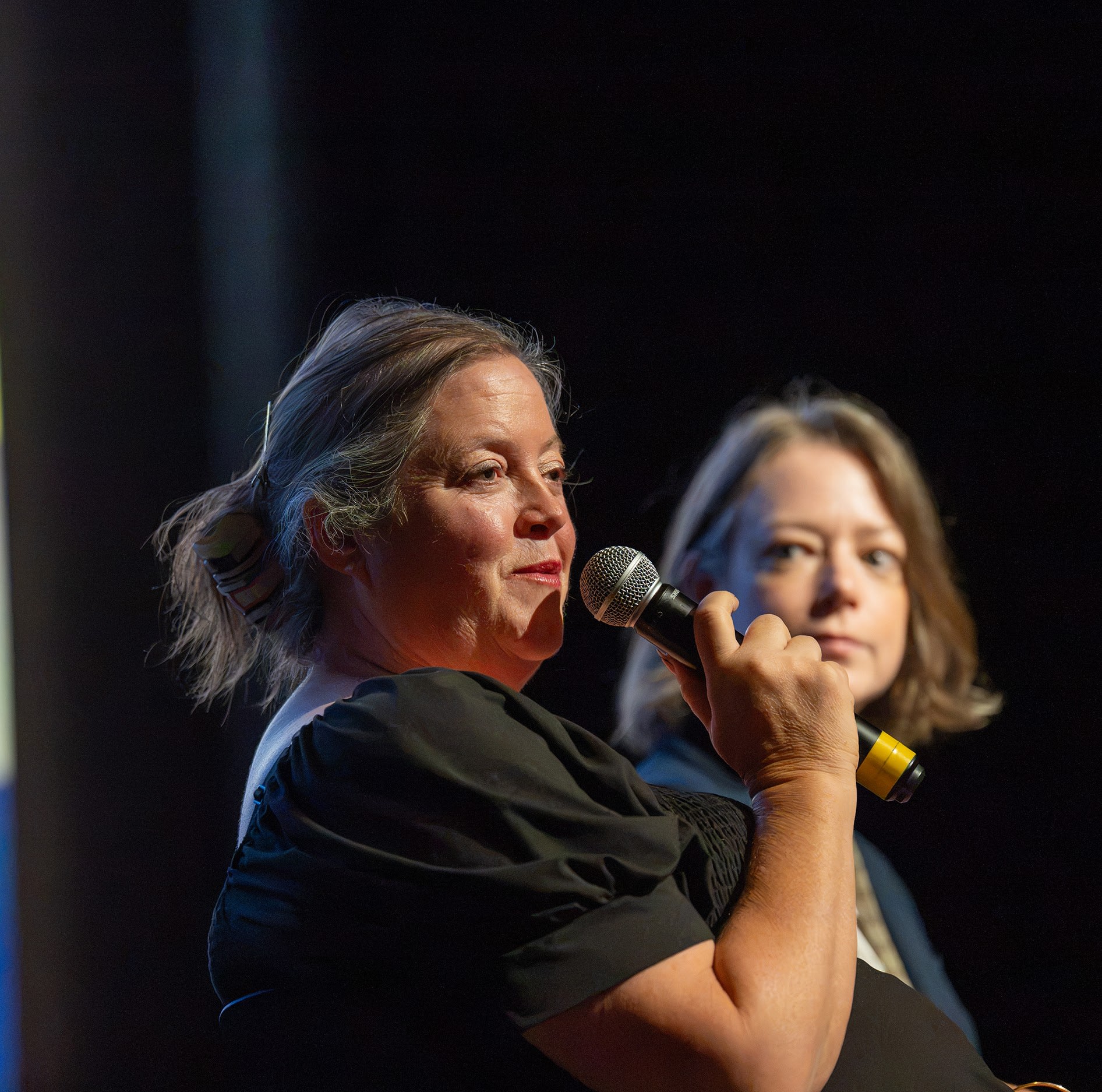
Sherry Scheline, Director of the Donnelly Idaho Public Library,
speaks to the audience after the screening of The Librarians at Cornell.
“HB710 forced us to limit library access to adults only, which was heartbreaking,” said Scheline. “Until the Cornell First Amendment Clinic and co-counsel came to my aid, I felt totally alone trying to both navigate the statute’s requirements and fight back against the unconstitutional ban. The Clinic has been an invaluable resource to us—we simply could not have afforded to mount this fight without their help.”
While the case moves through the courts, Sherry and the Clinic are making sure the public understands what’s at stake, not just for one Idaho library but for every community’s freedom to read. On September 29, 2026, Sherry joined her counsel, Clinic Stanton Fellow Daniela del Rosario Wertheimer, and Foley Hoag partner Kelly L. McNamee, for an eCornell Keynote, The Right to Read: A First Amendment Challenge to Book Bans. That evening, the Clinic hosted a free screening of The Librarians, a documentary about librarians on the front lines of the nationwide wave of book bans, followed by a conversation with Sherry, Dani, and Kelly about the lawsuit and what it means for libraries everywhere. Although a tough film to watch, audience members received a crash course in book banning and the ways they can help fight to restore access to free speech—no matter where the bans occur.
Clinic scores big win for public scrutiny of immigration enforcement
On October 8, U.S. District Judge Anthony Brindisi of the Northern District of New York ordered key records unsealed in a federal prosecution that arose from an immigration arrest. The Clinic brought the motion on behalf of The Post-Standard and Syracuse.com, after the government abruptly dropped its case against Marvin Aguilar-Garcia, who had been charged with assaulting a U.S. Border Patrol officer with a car manual during the arrest. The case was dismissed just five days before trial, but much of the record remained under seal, depriving the public of key information about immigration enforcement activity in its neighborhoods.
"Our client asked a simple question: why did the government drop this case five days before the scheduled trial date? Today’s decision brings us much closer to an answer. Courts work in the open, and that principle doesn’t change because a case involves immigration enforcement." —Michael Grygiel, Foley Hoag partner and adjunct professor at Cornell Law School
The Court ordered the release of the U.S. Attorney’s letter asking to drop the case, with only limited redactions. The parties have 14 days to propose redacted versions of the letter and remaining sealed filings, including the dismissal letter, and the Court also directed that three missing files be added to the public docket.
The Court unsealed filings revealing social media evidence that the Border Patrol agents involved in the arrest were members of “I’m 10-15,” a private Facebook group for agents that drew national scrutiny for posts joking about migrant deaths. These documents directly affect the officers’ credibility. The court allowed only narrow redactions of personal identifying information and rejected the government’s argument that the filings should stay fully sealed.
Shortly before trial, the grand jury returned a “no true bill,” rejecting the government’s request to issue a superseding indictment against Aguilar-Garcia. Finding no governing precedent on the question, Judge Brindisi ruled that this grand jury action should not be kept from the public, notwithstanding the secrecy that attaches to most grand jury deliberations.
When the government brings and then abandons a prosecution—particularly in the highly charged context of immigration enforcement—the public has a right to understand why. Here, the docket was so heavily sealed that the public could not know why the case was voluntarily dismissed. This decision reaffirms that courts operate in the open, even when they involve grand jury actions, and it gives local journalists the records they need to hold public officials accountable.
As co-counsel Michael Grygiel, a partner at Foley Hoag and adjunct professor at Cornell Law School, put it: “Our client asked a simple question: why did the government drop this case five days before the scheduled trial date? Today’s decision brings us much closer to an answer. Courts work in the open, and that principle doesn’t change because a case involves immigration enforcement.”
Read more about the case from Syracuse.com:
Syracuse.com goes to court to unseal documents in suspicious immigration arrest - syracuse.com
Your support matters: Secure the cornerstone of democracy
Free speech isn’t partisan—it’s the cornerstone of our democracy. When this cornerstone is under attack from all sides, we need bold, principled defenders more than ever.
Your gift today is the first step in establishing a permanent endowment that will expand our capacity to take on more vital cases, give more students transformative legal experience, and, most importantly, train the next generation of principled advocates for free expression.
Join us in protecting that vision—for today, and for years to come.
Supporting our project
If you would like to make a gift via check, corporate match, or securities, please visit: https://community.lawschool.cornell.edu/alumni/give/ways-to-give/.
For more information on this project or to make a larger gift, please contact Lynne Haberstock at lth7@cornell.edu or 607.255.2077.
As a registered student organization, we are committed to equal access to all of our programs and do not discriminate based on any protected identity status.
$50
Protect diverse viewpoints
Stand with the Clinic and defend free expression across the political spectrum.
$100
Expand opportunities
Give more students transformative legal experience, and provide greater resources to train the next generation of principled advocates for free expression.
$1,000
Support local journalism
Show your support for the essential role of local journalism in our democracy and protect local journalist’s access to pro bono legal services.
$5,000
Safeguard essential freedoms
Ensure that the Clinic can take on more cases and continue to challenge the erosion of free expression on national and local levels, reaffirming its critical role in American democracy.
$10,000
Ensure excellence
Secure the Clinic’s role as a national leader in both litigation and in training the next generation of principled defenders of free speech for generations to come.
$25,000
Honor a legacy
Honor Mark Jackson’s lifelong commitment to free speech and ensuring the clinic’s work lives on.